Contact
Book a 30-minute technical diagnosis
Share the business context first. I will help assess whether the AI application is worth building, how to approach it, and where the main risks are.
Telegram @NieErAI Message me on Telegram
Cases
These summaries focus on the problem, architecture, implementation tradeoffs, and result without exposing private customer data.
The backend core is complete, covering capability contracts, task execution, credit ledgering, permission boundaries, object migration, path traversal protection, and DAG flows. It is not production-proven yet.
The pipeline supports pause and resume for long-running training-data jobs. Cleaning runs at minute scale, while augmentation may run for tens of hours depending on data size. A Response augmentation infinite-loop incident was diagnosed and fixed. No training-quality, cost, or business KPI improvement is claimed.
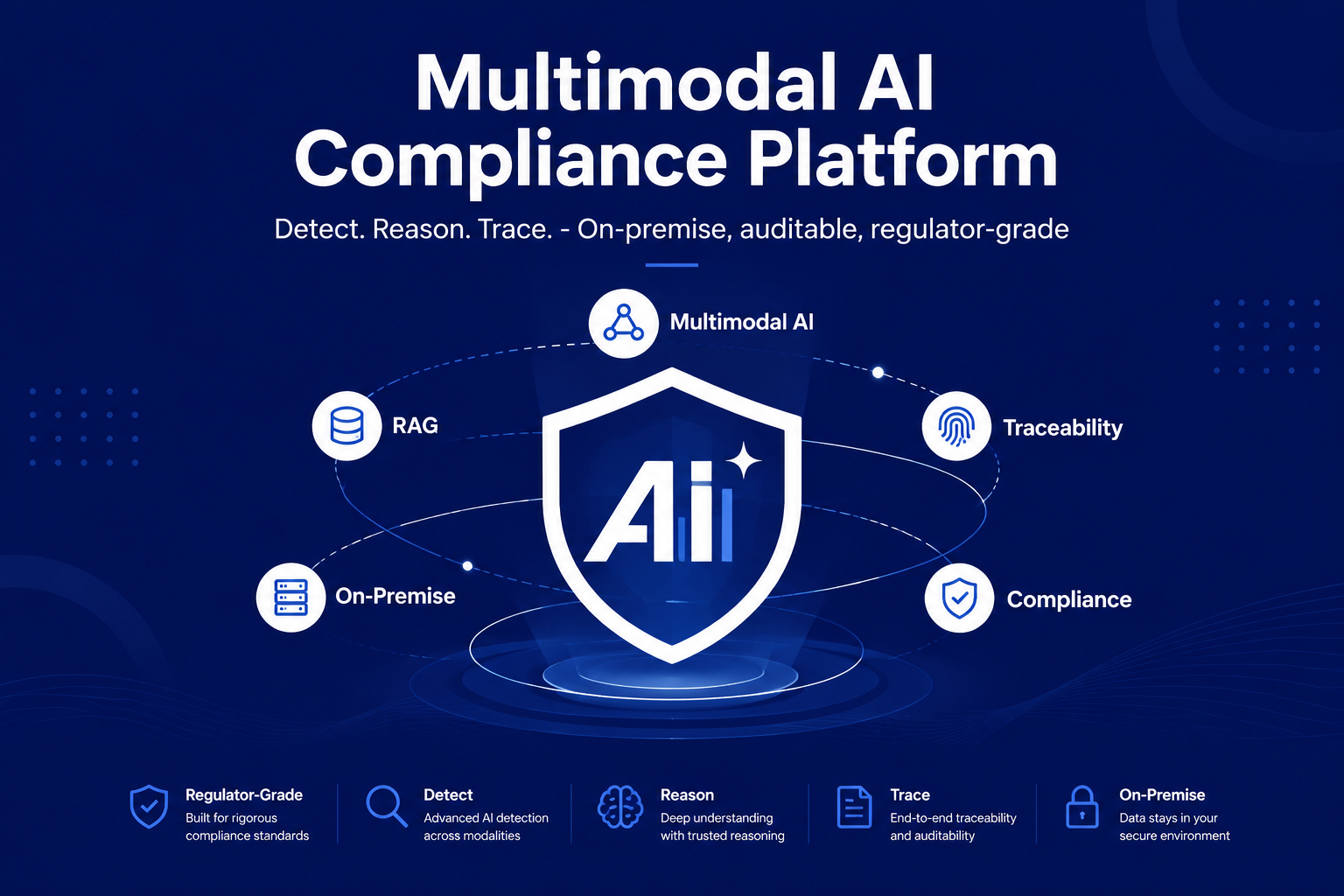
The offline training toolchain is built and runs end to end, locked down by hundreds of automated tests; a single command completes the full raw-data-to-cleaning-to-labeling-to-training-samples-to-evaluation pipeline in seconds on an ordinary CPU machine, no GPU required. The training and anti-forgetting configuration already passes LlamaFactory's real parsing checks, so a single command starts training once GPUs are available. The real model has not yet been trained, and verdicts shown in the demo come from the rule engine, representing recognition capability rather than trained-model performance.
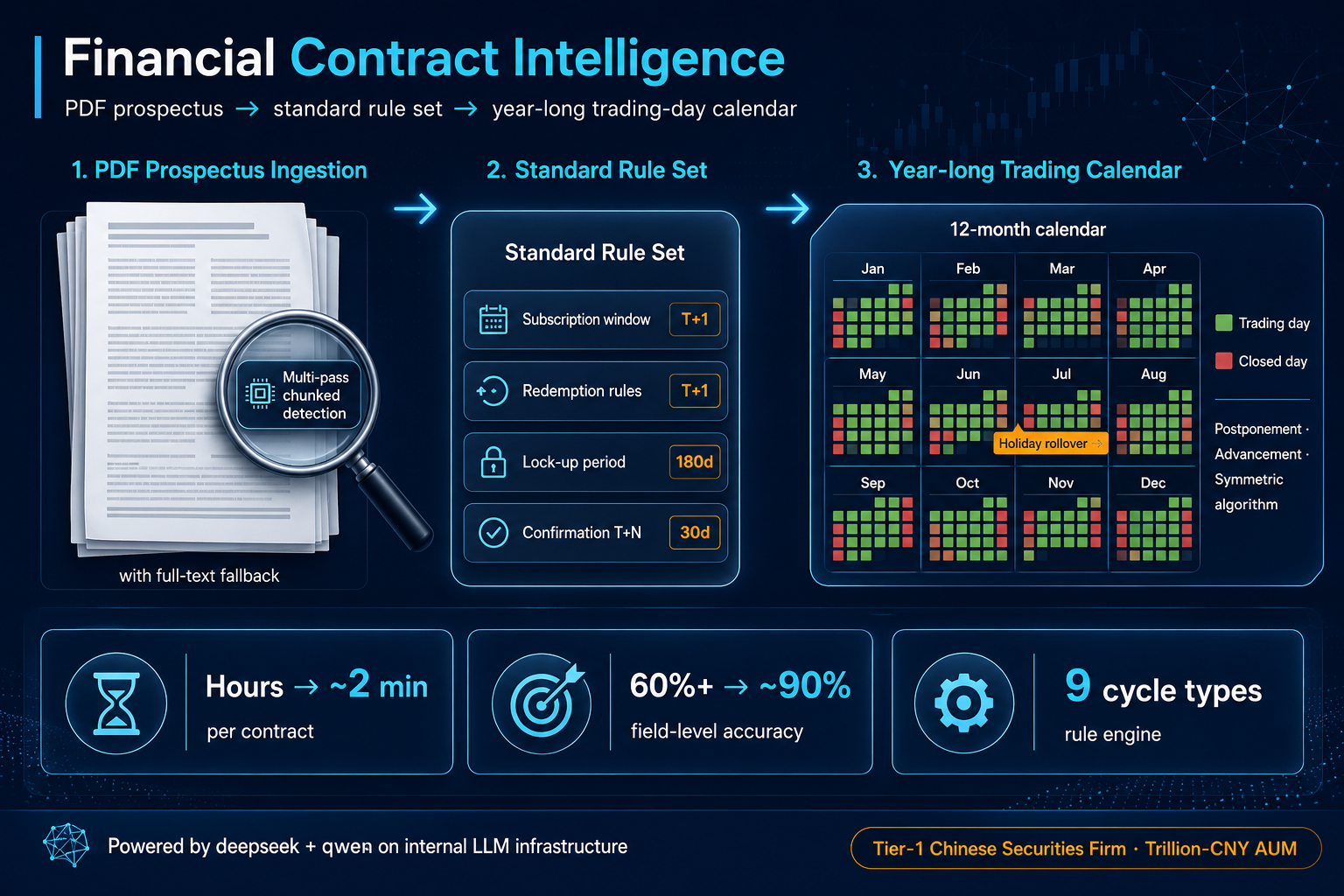
Processing time moved from hours to about two minutes per contract, and field-level results improved from the 60%+ range to around 90%; the workflow still keeps human review for high-risk and ambiguous fields.
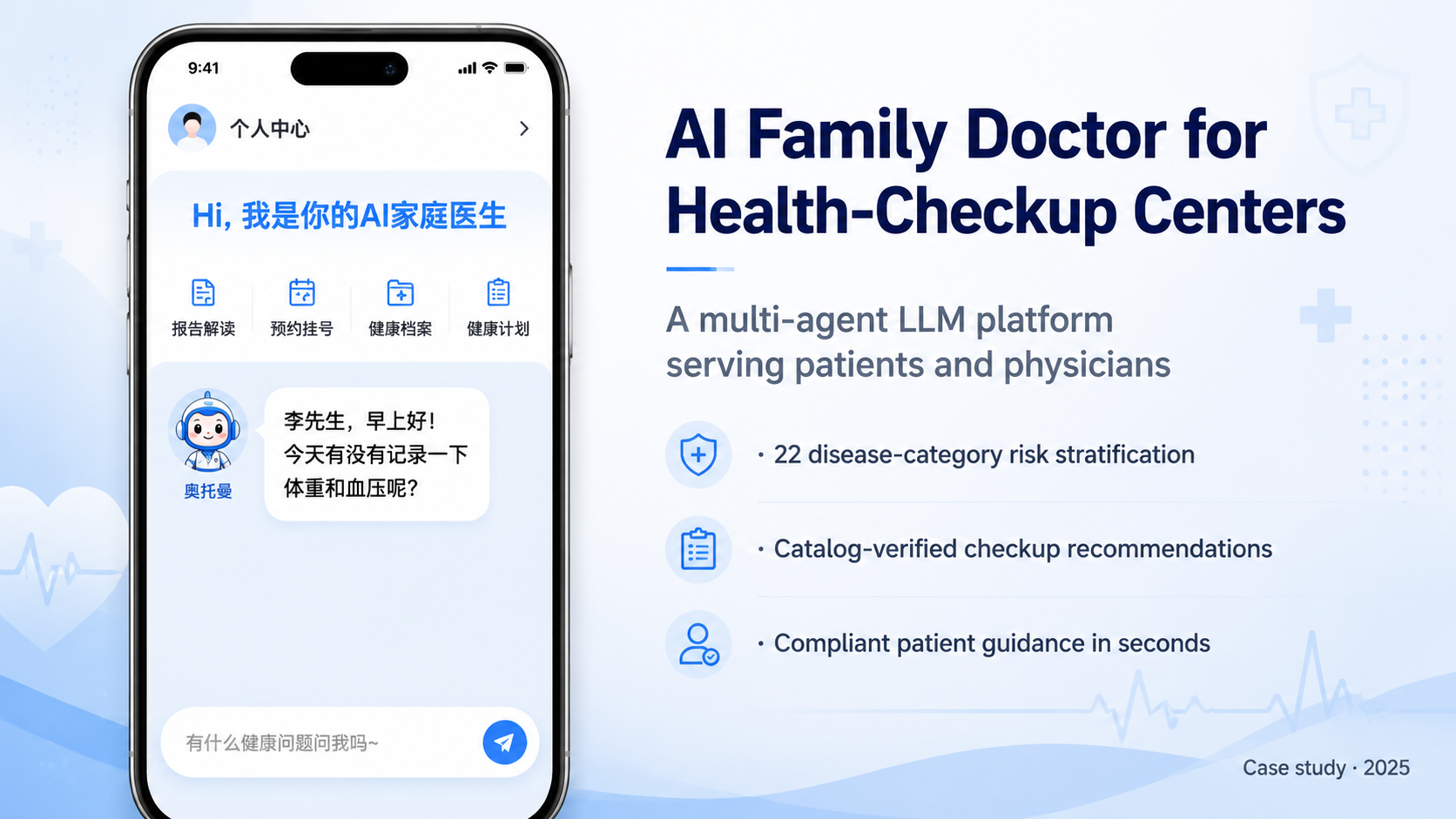
The pipeline established four production-oriented generation paths for recommendations, medical explanations, advice, and contradiction detection; recommendation outputs were checked against the institution catalog before fields could pass through, contradiction detection accumulated 13 named false-positive exemptions, and writing rules were formalized for both explanation and advice outputs.
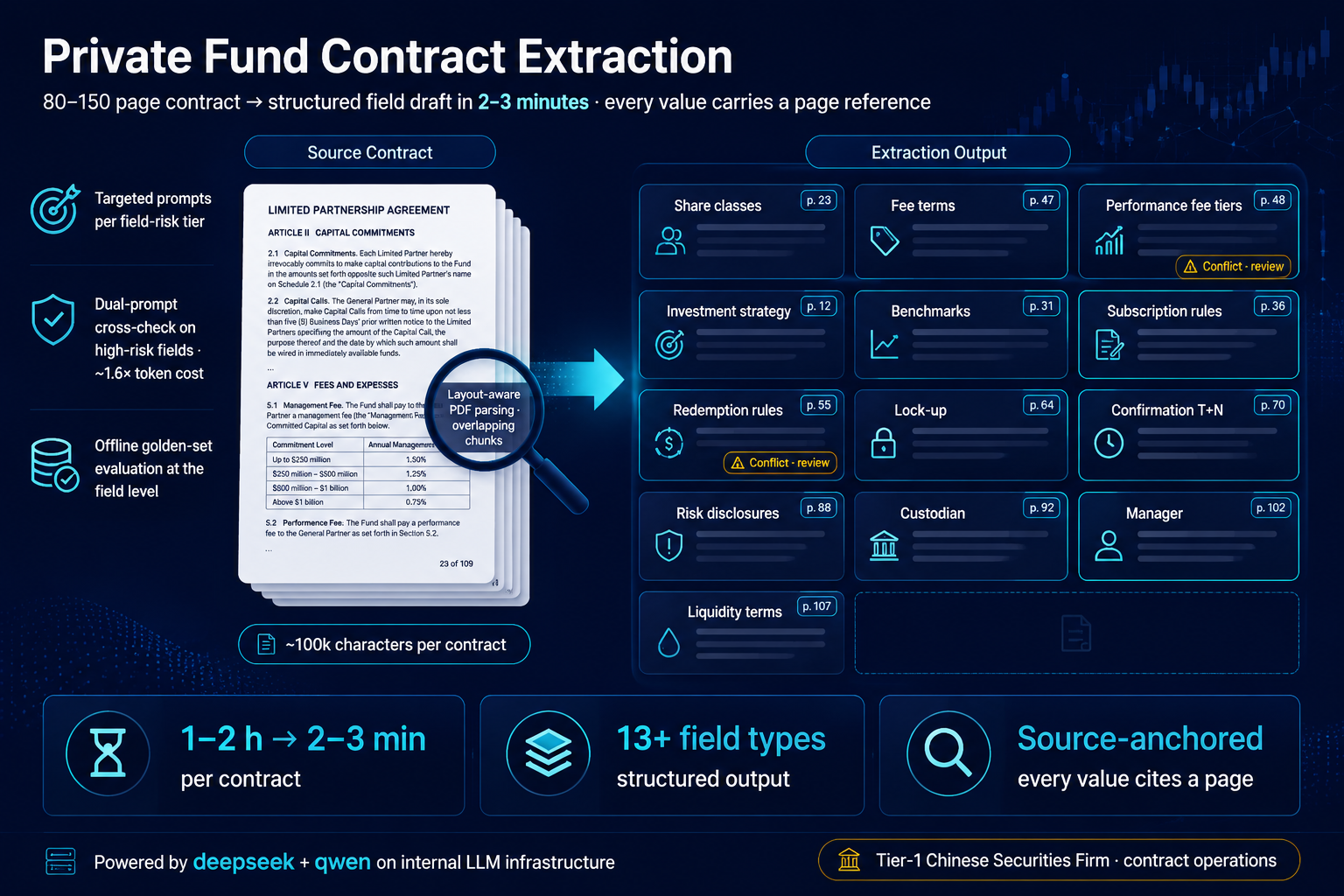
A single 80–150 page contract (~100k characters) goes from upload to a structured field draft in about 2–3 minutes, versus roughly 1–2 hours of manual reading and entry per contract; extraction covers 13+ core field types, and an offline golden-set evaluation keeps every prompt and process change measurable at the field level.
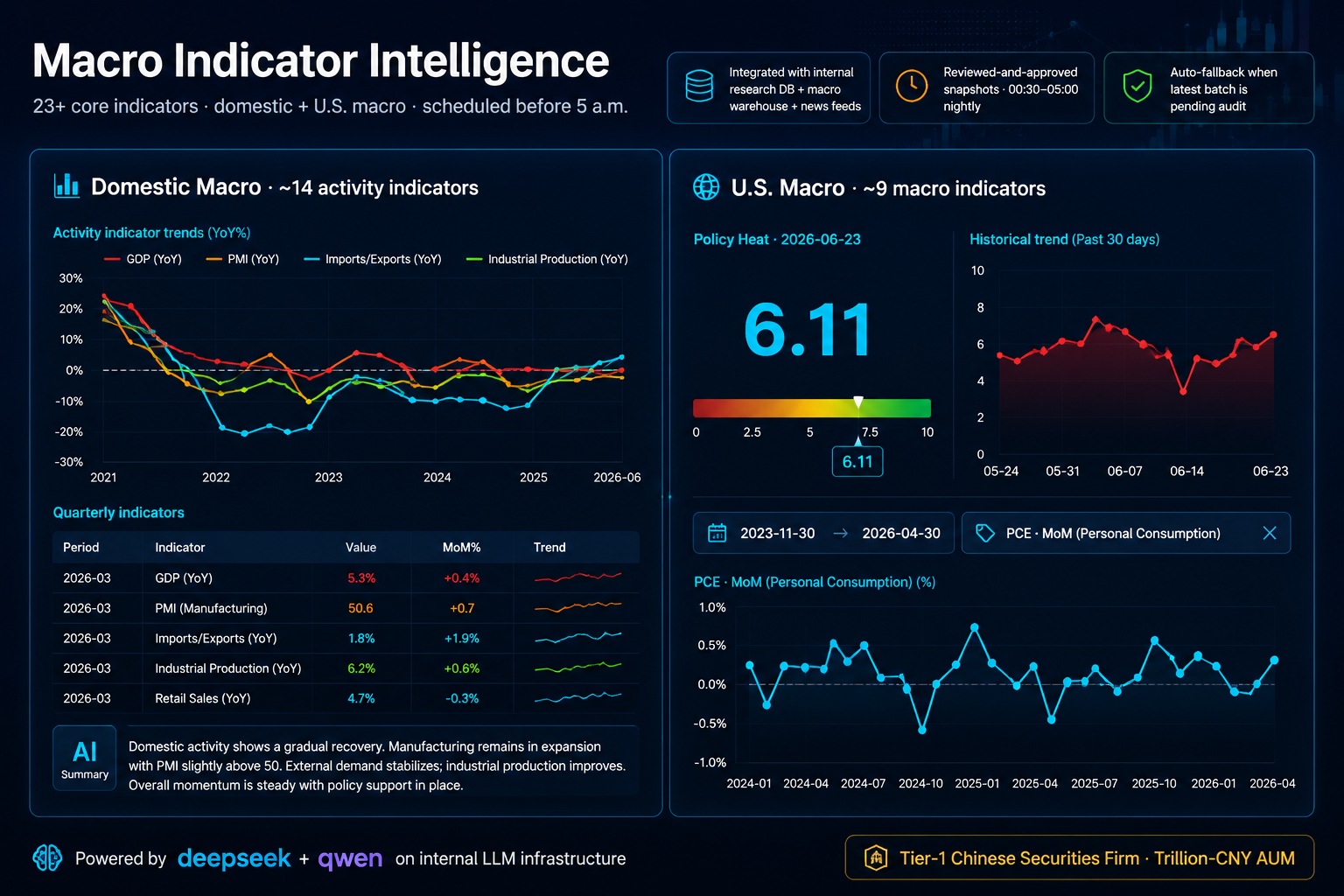
The full pipeline runs nightly in about 00:30–05:00 with the report ready before 5 a.m., covering 23+ macro indicators (~14 domestic activity indicators and ~9 U.S. macro indicators); daily volume converges from thousands of news insights to about a hundred indicator-level insights and one fixed-structure report, with policy direction kept as a traceable time series back to source material.
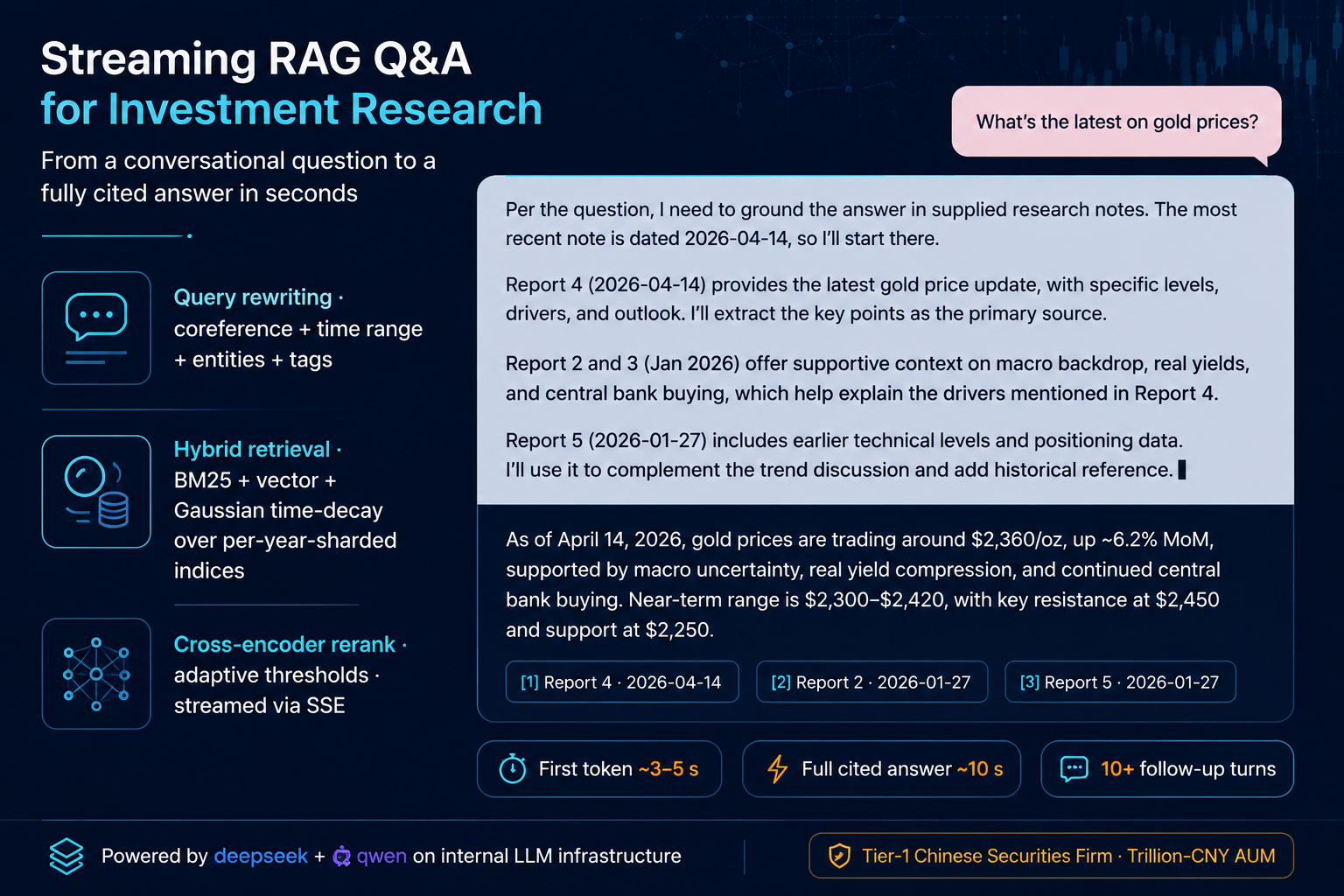
The system connects tens of thousands of internal reports and tens of millions of news items; answers begin streaming in about 3–5 seconds and complete with citations in roughly a dozen seconds, supporting 10+ follow-up turns without losing the thread and refusing when evidence is insufficient — so users spend less time finding material and more time judging it.
Contact
Share the business context first. I will help assess whether the AI application is worth building, how to approach it, and where the main risks are.